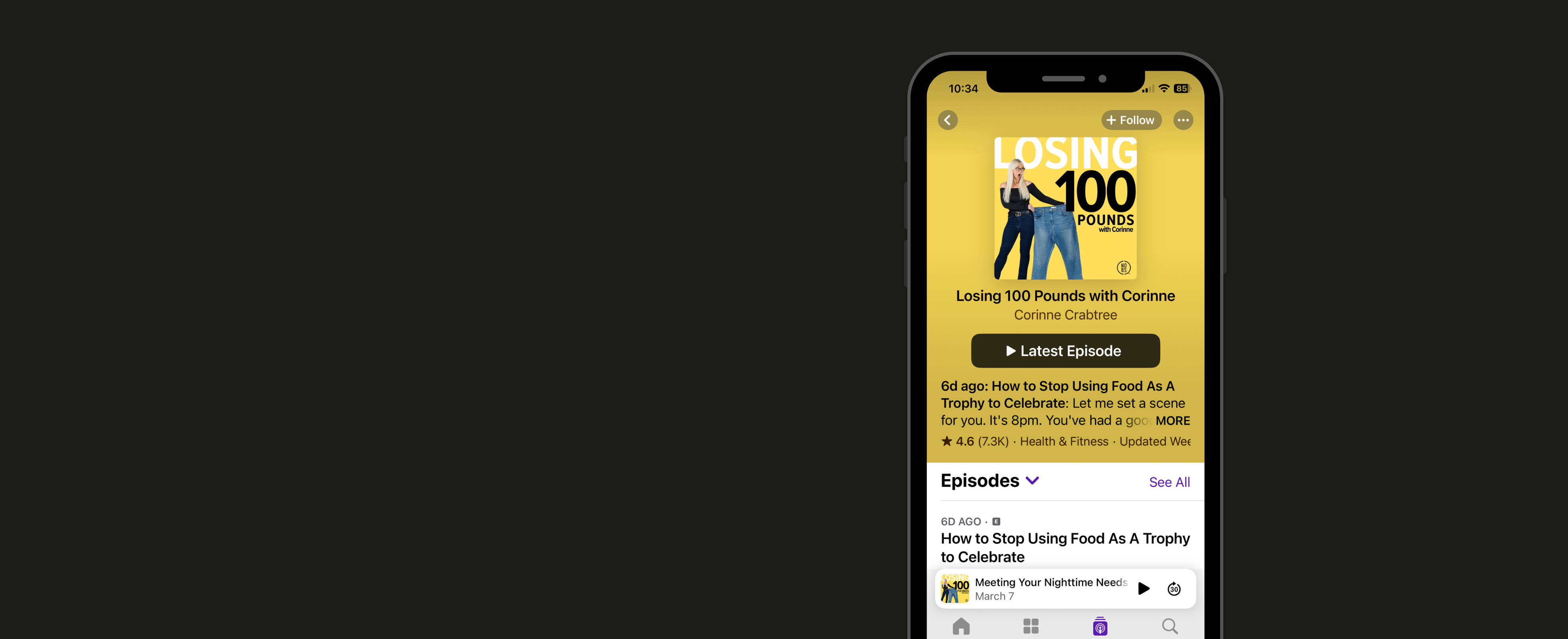
Okay, everybody, welcome back.
Today, I want to talk about why some of us have such a hard time stopping eating food that tastes really, really good.
This comes up a lot inside of No BS, where how I teach everything is we are going to lose weight the way we’re going to live our life. And one of the things that I think is super important is you deserve to be able to eat really good food and tasty food. We shouldn’t have to cut all of it out in order to lose weight.
The problem, I have always believed, because it was so true for me, is that when you are losing weight, the problem isn’t the foods you eat nearly as much as when I eat certain foods, I’ve probably been eating them under certain conditions. Either I only eat them when I give myself permission to break a diet, I only eat them when I’m stressed, I only eat them when I’m tired, I only eat them when everybody else is eating them. There are like a million reasons why.
And so when food tastes really good, and you combine that with a habit of only eating under conditions like I give up, I quit, I’m stressed, I’m tired, I’m lonely, I’m bored, it’s free, I don’t want to waste it, when you do that, you’ve got a habit running. And so one of the things we have to do is learn how to break that habit.
And there’s another component to it. Very often when it comes to tasty food, we have a habit where we just keep going because we are in the habit of thinking, when we’re eating it, that we’re being bad. We have a habit of thinking, when we’re eating it, that we screwed up. And when we feel like we’re bad or we feel like we screwed up, what do we do? We eat more because we think, why bother? So we’re kind of in that perfectionist black-and-white habit.
And then you’ve got the last big component when it comes to tasty food, which is for a lot of us, we’re eating it because we are having some type of emotional collapse. So when I’m bored, when I’m tired, when I’m stressed, when I’m exhausted, when I’m lonely, when I am not feeling good enough, when I feel like the weight of the world is on me, there are a thousand emotional reasons why we turn to tasty foods. We turn to tasty foods so we do not have to feel that way. Or we turn to tasty foods in order to allow ourselves to finally feel relaxation, to finally feel numb, to finally feel comforted.
So when you take those three things and when we think about tasty foods, it is crystal fucking clear the problem isn’t the food. It’s the habit we’ve built around it. It’s the inability to feel certain things without eating. It is the habit of trying to take moments in our life that are too hard for us and trying to fix them with food. So we’re coping with food.
Now, I wanted to explain all of that because what I want to do is I want to help you get to the bottom of why it’s so hard when you eat something you love and it’s hard to just stop. It’s hard to stop at one serving. It’s hard to stop when you’re at enough. And this really happens a lot.
So in my program, that is why we focus on it. It is not so much what you eat. It is always, let’s explore why. Why do you choose this food? Why in the moment is it specifically hard for you? Because there are a lot of reasons.
And I know, y’all, I was the same way. When you eat something that tastes good, it doesn’t matter how hard you try or how good your intentions are. It just feels like you can’t stop once you get going. And it’s not that you don’t want to stop. Sometimes women will tell me, “I am in the middle of doing this, Corinne. I am telling myself to stop, and I want to stop, and I feel like I can’t do it.”
And I think all of us, if we’re being honest with ourselves, know that we don’t want to cut these foods out of our lives for good. We want to be able to eat these foods that taste really good like normal people can. It’s just not easy for some of us. And then some people will even tell me when they’re eating these tasty foods, they don’t even realize they’re eating too much until they’ve already eaten too much.
So whether or not you are someone who starts eating them and you’re like, “Oh my gosh, it’s like I just woke up, Corinne, and suddenly it was all gone,” or you are someone who says, “Oh my gosh, I started eating it and I just felt like I couldn’t stop. I wanted to stop and I just couldn’t do it,” I think today is going to be very helpful for you.
So let me ask you this question, because I think this is a great place to start. When you lose control around the foods you love, what are you telling yourself is the problem?
A could be, I don’t have enough willpower.
B could be, I just need more discipline, Corinne.
C is, well, I don’t try hard enough, so I need to try harder.
D, something is just wrong with me.
E, there are just certain foods I can’t eat.
Now, if we were sitting here and you and I and like 50 of your closest friends who all had this problem were together, I would get a mix of those answers. And I bet you might even be sitting there thinking, holy shit, how about all of the above? And I even got more reasons.
I will tell you, I have worked with thousands and thousands of women when it comes to losing weight. I have lost my own hundred-plus pounds. And one of the things that I know is that you are not alone in this. All of us have at least one of these things. For myself, I had all of them.
So I don’t want you feeling broken. I don’t want you feeling bad or anything like that simply because one of those is your answer. Because I’m going to promise you this: none of those are the real answer. That’s the bullshit the diet industry has fed you.
Your answer is really important because it tells me what you keep trying to do in order to fix this problem. And I’ve always said, you’ve got to have the right problem in order to get the right solution.
So a lot of times when we think our problem is willpower and discipline, or we’re just not trying hard enough, or certain foods I just can’t be around, we try to fix the problem with tasty foods by doing things like this: we try to give up foods we love, like sugar and carbs. We remove our trigger foods from the house. So we might start a diet and say like, “All right, fuckers, no more chips and cookies in this house.”
Very often we will tell our loved ones, “Please don’t let me eat anything like this when I want it.” I used to do that to Chris all the time. I was always trying to make him like my diet boss, the one who was in charge of me. And that was a terrible position to put him in because for a long time, he would do exactly what I would tell him, and then what would happen? Bitchy the Clown would come out. All of a sudden I was saying, “You just think I’m fat. You just think I need to lose weight. Don’t tell me what to do.” Even though I was the one telling him to tell me what to do. I know it makes no sense, but it was one of the things I tried for a long time.
Now, I’m going to tell you, there were certain times of my life where that worked, but that was only after I became a more emotionally stable bitch. In my previous time, when I was very desperate to lose weight, I had very low self-esteem. When I would tell him to help me and then he would try to help me, I would act like he was doing something to me. Then once I got to where I realized how much I really wanted to lose weight, how much I really valued his support, and I really knew he did not think of me the way I thought of me, then I could have him do that. And in the moment, I could say like, “Oh yeah, I remember. You’re just trying to help me.”
So let me guess what happens, though, when we do all of these things, when we’re giving up foods and removing our trigger foods and banning shit. You do really good for a little bit. That’s what I used to do. I could do good for a little bit. I could go a week. I could sometimes go a month. I could do like a 30-day don’t-eat-this-thing. I could do that. And then at some point I’d be like, “I’m going to just try this again. And I’m going to be really balanced. I’m going to practice moderation.”
And I’m going to tell you, I love moderation. I think we should enjoy all the things. The only problem is that would never happen for me. I would start eating those foods and then, smack dab in my face, I would be sitting there eating like a crazed person again, as if I was out of control. I would eat it so fast you would think I was in jail and scarfing it down just in case somebody was going to shank me for my cookie.
Because the truth is, if any of those things like banning foods, trying to moderate, and all this other stuff, if it really worked, we would have all fixed this problem by now. We wouldn’t still be struggling with the same foods, the same frustrations, and the same feelings like you just can’t be trusted to eat things that taste good.
So what does all this mean for us? I think it means that we’ve been trying to fix this the wrong way. Those tactics simply don’t work because they’re not fixing the real problem. And this is super important. Those tactics, if they were going to work, girls, they would have already worked by now. You keep going back to them and they keep blowing up in your face. And so we have got to do something new, because they’re not fixing the real problem.
And then once you understand what’s really going on when you eat foods that taste really good, guess what, motherfuckers? It gets a whole lot easier to eat the foods without losing control.
But we still need to keep talking about this because we don’t even know what the worst part of all this is. Do you know what it is? It’s not that you lose control around tasty foods. The absolute worst thing that’s happening is what you say to yourself after you overeat. That is the real kick in our asses.
The second you overeat, I bet you think things like, “See, I blew it again. I knew this would happen. I just can’t control myself.” That’s when it stops feeling like tasty food is the issue and it starts feeling like you’re the real problem. So we have this dual problem. We think the food is causing us problems, and then all of a sudden when we beat ourselves up, it’s like, well, you know what? It’s not really the food. It’s me. I’m the problem. I’m the asshole.
So many women I work with think something’s wrong with them because this is hard for them. They think they’re not normal, that they have some problem that all the other motherfuckers out there ain’t got. They look at their partners and their friends and their family members and they’re like, everybody else seems to be normal except me. Insert your Eeyore face.
And it feels to you like, man, these people have something in them, something innate in them, that I ain’t got. And the next thing you know, fear takes over. You start wondering if you can ever eat these foods without losing your mind. You start worrying you’re never going to be able to lose weight. You start thinking, it’s just who I am. I’m just some woman who can’t get her shit together around food. And so then all of a sudden it’s your identity that you are a shit show when it comes to eating foods that taste good.
And then we get into a circle jerk again of trying to manage tasty food the only way we know how. Go back to the drawing board and get all that shit out of the house. Do some diet where it cuts, like if you love sugar, “Oh, I need to pick me. I’m going to do the ketos. Do the ketos again. The ketos is what works.”
The ketos doesn’t work for you, I promise you. Because anytime you do that, you are just going to stay in your busted fucking cycle. And the biggest problem is all while this is happening, deep down, it’s always going to feel like something’s wrong with me and food has power over you.
Now, this is really important. Your reaction to all of this makes a lot of sense. It makes sense that you are trying to protect yourself by banning foods, getting rid of them, cutting them out, saying you’re addicted. I mean, just think about it. If you think those foods are harmful, what do we do with harmful things? We try to keep them away from us.
But I am going to tell you, the food is not what’s harming you. Losing control around food that tastes good is always happening for a reason. And it’s not because something’s wrong with you or you lack willpower. There is a real explanation for why this feels so hard.
So before we talk about it, keep in mind, there’s nothing wrong with you. You just haven’t been told why this keeps happening. And you haven’t been shown what actually helps when it does. That is it.
Most of us grew up learning how to avoid foods we love. Almost every diet is full of all kinds of restrictions. You’ve been brought up and raised to believe there are just good foods and bad foods out there. And if you’re over the age of 50, I promise you, you’ve seen those rules change about every 10 years.
We were just never taught how to eat foods we love in a way that works for us. So even if you’ve done calorie counting, you subtly got a message that said, “Oh, some foods are too expensive.” I remember my Weight Watchers days, way back in the day, the 5,000 times I tried it. Anything I liked was always high in points. That sent the subtle message to me that if I wanted to eat something that tasted good, I needed to starve. I had to save up my points, and then I would be somehow worthy of having it.
But here’s the secret. Diets that include cheat meals, banked points from exercise, and all that bullshit, that actually triggers your mind to ask for a lot of that food the moment it gets it.
So if you’ve been struggling with eating tasty foods and keeping control over it, then you’re going to love what we talk about. Because the reason this has been hard for you has nothing to do with being broken, lazy, undisciplined, lacking willpower, not trying hard enough, or lacking some skill that everybody else in the world has but you. And more importantly, the food isn’t controlling you.
So if the food isn’t controlling you, guess what? It means this can be fixed.
So if none of that shit is true that you have been believing, I just want you to open your mind for the next little bit and just see how this feels. If you want to keep believing the food is the problem and you are broken, you get to. Have at it, sister. But I think it feels like shit. And I also think it ain’t going to help you lose weight.
So let’s talk about what is true. And it’s very simple. When you eat the tasty foods, they’re doing something for you. I’ll say it again. When you eat tasty foods, they’re doing something for you. They’re not doing anything bad to you. They’re doing something for you.
So they might help you relax. They might feel comforting at the end of a bad day. They might be the one enjoyable part of your entire day or your entire week, and the rest is a joy suck. They might even make you feel a little naughty, especially for all my girls out there that feel like you have to be good all the time, you have to do things right, you have to be the good girl. So sometimes eating those foods is the only time you ever get to feel like you’re breaking a little rule or you’re doing something just for you.
And if you don’t understand what a food is doing for you, guess what? You ain’t ever going to know how to handle eating them differently. You’ve been trying to fix that out-of-control feeling without really knowing the problem underneath. And when you don’t know the real problem, you will not use the right solution.
Just like I said earlier, it’s kind of like trying to fix a leak in your ceiling by placing a bucket under it. The bucket works until it’s full. Then you’ve got to get to mopping. You can mop really hard over and over again, but if you don’t fix the leak in the ceiling, if you don’t invest in the roof, it won’t matter what you do. It won’t matter how annoying it is. It won’t matter how hard you work on your mopping and your bucket skills. You’re going to have water issues.
And that’s what diets have taught us to do. They’ve taught us to just manage the mess, avoid the leaky roof, and blame ourselves when the bucket is full and the floor is wet again.
So being able to eat food that tastes really good without losing your self-control, it isn’t something magical that only some people get. You’ve just got to understand what’s actually driving you to keep eating them. And then you will finally know what you need to work on. And once you work on the right thing, the problem changes dramatically.
So I bet you’re wondering, “Well, what the fuck am I missing, Corinne?” Let’s get into it. Because it comes down to just a few simple things no one’s told you.
Missing piece number one: nobody ever explained why stopping eating something that tastes good feels unfair instead of simple.
For a lot of women, this is very common. It’s one reason why they can want to lose weight, but in the moment blow it to shit when they eat something they love. So let’s say you finally sit down with something you really enjoy, like pizza. You get a slice with a side salad. You know in your head this is going to be plenty of food. And before you even start, you start thinking, “This is great. Here I am. I’m going to be eating pizza despite my weight loss. I’m a baller.”
But for some reason, as you eat, you just can’t stop. It feels unfair that you can’t eat as much as you want. You want more pizza. You might even be angry that you get so little of what you want.
So a lot of my clients tell me this happens, and they feel batshit crazy about it. And if you think you’re crazy, you’ll never solve what’s really going on because the problem isn’t that you’re crazy for being mad that you don’t get to eat more of foods you love, even when if you were to eat a slice of pizza and a salad every day of your damn life.
Most women who experience this are using food as a major or only source of joy, entertainment, stress relief, or their breaks.
So, for example, I had a client who got upset every night when she would eat dinner, even though she was eating the shit she likes to eat. She was now, though, only going to eat the amount her body needed, which meant she got less of the food she likes to eat. So for her, dinner was the first real break in the day. All day she was pushed and pulled in a million directions. She had a stressful job as a nurse. She had kids that went to two different schools. And she had a husband who worked longer hours than she did.
So dinner wasn’t just the time she ate. For her, dinner was an oasis in her day. And when she started eating what she physically needed, that meant she ate a lot less. A lot of her serving sizes reflected what I would call her emotional hunger.
So I want you to think about this. For her, when she stopped eating, she was thinking, “I’m stopping my oasis-in-the-day moment. I’m stopping the first real break of the day.” So of course she would want to keep eating. Of course she would be upset. Of course she would be angry because she wasn’t just eating less food. She felt like her break, her rest, her reward, her fun, her comfort was being taken away.
Because when you’re eating your tasty foods, if they represent something else to you, eating less means you get less of those feelings. So the tasty food was never the problem. It was never that she couldn’t control herself around pizza or a cookie. Not knowing how to stop using tasty food to make up the gaps of your life, that was her missing piece. And that is why she worked with us.
All right, missing piece number two: you don’t even realize you’re restricting.
So a lot of women think good food has some magical power over them. So once they start eating it, it’s like, “Corinne, when I just start eating, there’s no way to stop. It just takes over.”
Now, let me explain this. There are two types of restriction that make controlling yourself when you eat really hard.
The first one is called physical restriction, and it’s where you simply cut foods out. Now, it makes sense that when you start eating something that you’re not used to eating, you would be highly tempted to overeat it simply because research shows that something you think you don’t get very often, you will want to overdo it when you get it. Plus, if all you do is cut a food out or overeat a food, then you either have to never have it, and that’s one habit, or you have to overeat it because you have a habit of just eating too much of it.
But I think for most of us, it is because when you don’t get something very often, when you’re not exposed to it much, you’re going to want to overdo it when you get it. It’s like when you go on vacation. If you don’t get a lot of rest and fun most days of your life, you try to squeeze in every ounce of rest and fun you can on vacation.
But there’s also another type of restriction that most women don’t know about that’s equally as important. And it’s called mental restriction. And even if you’re doing weight loss the way I teach it inside No BS, we eat the foods we love so we can lose weight the way we want to live our lives, mental restriction will make you want to eat too much of good-tasting foods, even though you want to lose weight.
So have you ever thought any of these things while you’re eating something that tastes good?
I shouldn’t be eating this.
Girl, I’m being bad.
I should be eating something healthier.
I hope no one’s judging me for eating this.
I bet this is going to make me gain weight.
All of these types of thoughts make you feel bad. And that’s important because while you’re eating something tasty, what are you supposed to be feeling? Good. You’re supposed to be enjoying it. But when your mental restriction narrative on the inside of your head is running, you ain’t feeling that. You’re feeling bad and naughty and ashamed.
So our mind thinks, wait a minute, I ain’t getting what I think I should be getting. You know what? I think you should eat more. I want you to keep eating until you feel what I think you’re supposed to be feeling.
And that’s one of the missing pieces of weight loss. You’ve got to know, how do you stop mental restriction so that you don’t feel like you have to keep eating? And how do you break the habit of physical restriction so that you don’t just have two gears: I don’t have it at all, or I eat it as if I’m never going to get it again?
All right, now let’s talk about missing piece number three. The way you eat foods you love, it is a habit, y’all. This is not a personal flaw.
So our minds are wired to habitualize everything they possibly can, including how you eat. So we eat at about the same pace when we eat. We sit and eat in the same spots, like a certain chair at the kitchen table, or we will sit in the same spot on the couch. We tend to eat off the same plates.
For example, I have several types of bowls and plates in my house, but I eat almost every single thing out of my favorite-sized bowls. And I have 10 of them because I don’t like running out of them. I eat breakfast in them. I eat my salads in them. I eat as much as I can in those bowls because I like them.
So we eat at a habit pace. And most of us have habit foods that we also will eat on repeat.
So let me ask you this. Do you ever go to your favorite restaurant and order the same things? Or do you go to your favorite restaurant and order something new every single time? You’re like, “No, I always order different things.”
One of the things we have to realize is that we habitualize so fast. And then we just chalk this up to, well, this is just what I like. This is just what I don’t like. But what’s really happening underneath the surface is your mind found something that it liked to do, and it said, all right, I like this just enough. Let’s just put that on habit and put it on repeat.
So it’s really important that you understand that your mind has two parts. There is the thinking part of your brain, and it burns tons of calories every single day. And if it’s used too much, it’s going to wear out. It’s going to wear you out. And it’s the part that makes all the decisions. It does the math. It pays the bills. It helps with the homework. And it makes all the plans. Your brain protects how much you use this part of your brain so it can turn it on at the moments that you truly need it. And it’s only really used about 5 to 10 percent of the day. Your brain is always trying to save that part for the moments we really need it.
Now there’s another part of your brain, and it burns very few calories. And it represents about 90 to 95 percent of your day. And that’s your habit brain. And the habit brain’s whole goal is to take the load off of your thinking brain.
And when you don’t realize that all the little habits you have around food that tastes good, you are going to find yourself starting to eat them and then just lose control. You probably won’t be scarfing the food down and eating in a frenzy, but it’s more like you start eating and then realize at the end, “Oh shit, I ate too much.”
When our habit brain takes over, it’s like we’re zombie eating. And what we end up doing, rather than realizing, “Oh, I need to break patterns in my eating of these foods,” we end up blaming ourselves. We end up blaming the food instead of realizing there are just a lot of tiny habits around this food that I could interrupt and make all of eating this tasty food so much easier on myself.
So a huge missing piece for women is creating what we call sensory eating experiences, which retrain your habit brain on how it eats these tasty foods.
So once a woman understands why stopping feels so hard, guess what happens? The next question is always the same.
“Okay, so what do I actually need to do, Corinne?”
What you actually need is help finding all the stuff that’s going on underneath the surface. Because when you don’t know what’s happening inside you, you end up wasting a ton of time trying to make yourself just eat better, just eat less, just try harder. Just use your willpower. You just need more discipline. And you just start thinking that those are the problems when they’re not.
Too many people make this sound like it’s just about eating less and eating healthier. I’m going to tell you, if all the bros out there are correct, all the husbands out there are correct, all the mamas who have been browbeating us all our life to lose weight, if they were correct that we just needed to try harder, we just need to eat a little less and eat a little healthier, oh, we would have had this fixed a long time ago because we’ve been trying this for decades probably, if you’re listening to this.
I promise you that when you understand what’s really going on underneath, fixing your eating gets so much easier. Eating less will feel simpler. Eating healthier will feel easier. Eating what you love to eat becomes a part of losing weight. It no longer is the thing that’s stopping you from losing weight. It’s like you have to fix the underneath stuff first so that doing what you want to do doesn’t feel like you’re always fighting it. It won’t feel like you’re always trying to fight foods you love.
So the real problem isn’t stopping when you eat what you love. I think the real problem is that you don’t want to stop for reasons you’ve never been shown before.
I want to say this again. It’s so important that you hear this. The real problem isn’t that when you eat foods you love, you can’t stop. The real problem is that you’re not stopping those foods because you’ve never been told the reasons that are causing you to eat more to begin with. And when you fix the reasons, stopping doesn’t feel like a battle. It starts to feel easier and easier.
And just as important, you’re going to have to have a way to handle what happens after you overeat these foods. Because while you break the habit, while you figure out what’s really going on, you are still going to probably sometimes eat too much of it. And if you only beat yourself up afterwards, you make yourself feel terrible, you sit around frustrated and upset with yourself, you will stop trying it my way. You will go back to your broken way, and you will get stuck in that cycle of taking foods away and then overeating them over and over and over again.
What I need you to feel is I need you to learn how to get really curious about what goes on inside of me that causes me to eat too much of these foods. Of all the things Corinne talked about, the three missing pieces, which one or what flavor of the missing pieces am I experiencing this time?
Because if you did that, if you stopped beating yourself up, you would be curious. You’d feel reassured that there’s some science or some psychology or some brain-based reason that’s going on here instead of panicking that something must be wrong with you. You would know, “Oh, there’s a solution to this,” instead of thinking, “See, I’m just a failure. I always do this.”
This is why it’s so important you work on the right things when you want to lose weight instead of just trying to stick to some bullshit diet that is the latest fad.
When you find the hidden reasons you can’t stop eating foods you love, I promise you food stops feeling like it controls you. And once you have these simple things uncovered that we’ve talked about today, food really does stop feeling like it has power over you. You start feeling in control again without having to force yourself to be good. You finally understand what’s been driving this overeating of tasty food all along.
And this is exactly why I decided I wanted to create a mini course for my podcast listeners called Eating Foods You Love Without Losing Control. Because knowing why losing control around your favorite foods is really helpful. I’m sure you feel there’s some relief. It’s like, oh, there are legit science-based reasons why this keeps happening. There’s actually psychology behind this. That feels relieving.
But knowing what to change and how to do it is what actually is going to change things for you. So I created this mini course where we take everything we just talked about inside this podcast and you’re going to work through it. You’re not going to get a bunch of food rules like bullshit diets try to do. I will never tell you to be more disciplined, try harder, or use your willpower. And I promise you, you won’t feel like the food is the problem anymore at the end of this. You’ll start really realizing there are legit reasons.
So inside Eating Foods You Love Without Losing Control, I will show you how to uncover your unique hidden reasons why you want to keep eating when the food you love feels like it takes over, when the food you love tastes so good it’s hard for you to stop. We will look for the stuff that’s been running in the background for years without you even realizing it. We’re going to slow down all the moments so that you can actually see what is going on inside of me while I’m eating. And then you’re going to work on all of the reasons so that now you get to include these foods as a part of losing weight instead of having to ban them and feeling miserable that you can’t have them.
So it’s about a 30-day course. You will not have to listen to shit every single day. It’s broken out into little bitty short videos. But by the end of the 30 days, you’re going to have a lot less frustration and guilt about your eating. And before you know it, you’re going to start noticing that you feel like you’re finally able to eat food you love and it not just feel like a shit show.
So here’s what you get in the mini course. There are some short videos that tell you what you need to know to make eating food you love so much easier. Because I promise you deserve to understand what’s really going on because I do not want any woman who listens to my podcast feeling broken or like something’s wrong with them anymore because of how they eat tasty foods. I know there are really good reasons. And when you know them, I know you can fix them.
You’ll also get a companion guide that goes with all the little videos that you’re going to get. And that guide is filled with examples of what to look for and how to fix it. You’re going to get all my best tips for slowing everything down enough to where the hidden reasons start becoming very apparent.
And then as you go through the videos and guide, I promise you, you’re going to start thinking, “Okay, this makes a lot of sense.” And that’s going to help you feel the relief and the motivation that you need to try things that no diet has ever taught you to do.
So it’s that simple. You watch the short videos, you use the companion guide, you get to the root of what’s going on, and then I show you how to fix it.
So with the Eating Foods You Love Without Losing Control mini course, you’re going to go from feeling like foods control you to feeling like you are in control again. You won’t feel like you can’t eat food you love anymore. I think you’re going to know exactly how to eat them like what you would call normal people.
I promise you’ve struggled with food long enough. I know this can be easier when you work on the right things, and that’s what I help you do.
So if you go to the show notes, you will have the link to be able to order this course. All you’ve got to do is visit the page and I will have everything on there. It will show you exactly what you’re going to get, and it will tell you exactly how to buy it. And then you can really work on this.
I think you’ve probably spent enough time feeling like food has had enough power over you. I know you want to work on these things because you are so sick and tired of feeling like food is your problem. It’s the anchor around your neck. And this is really the answer, one of the many, but one of the most important answers, to how am I going to lose weight and keep it off the rest of my life?
So just check out the show notes and I will tell you how to get Eating Foods You Love Without Losing Control. It’s that little mini course. And I promise you that if you’re tired of feeling like food has power over you and you want help working on what’s actually underneath, this will be for you.
All right. That’s it for this week. Have a good one, and I will see you next week.