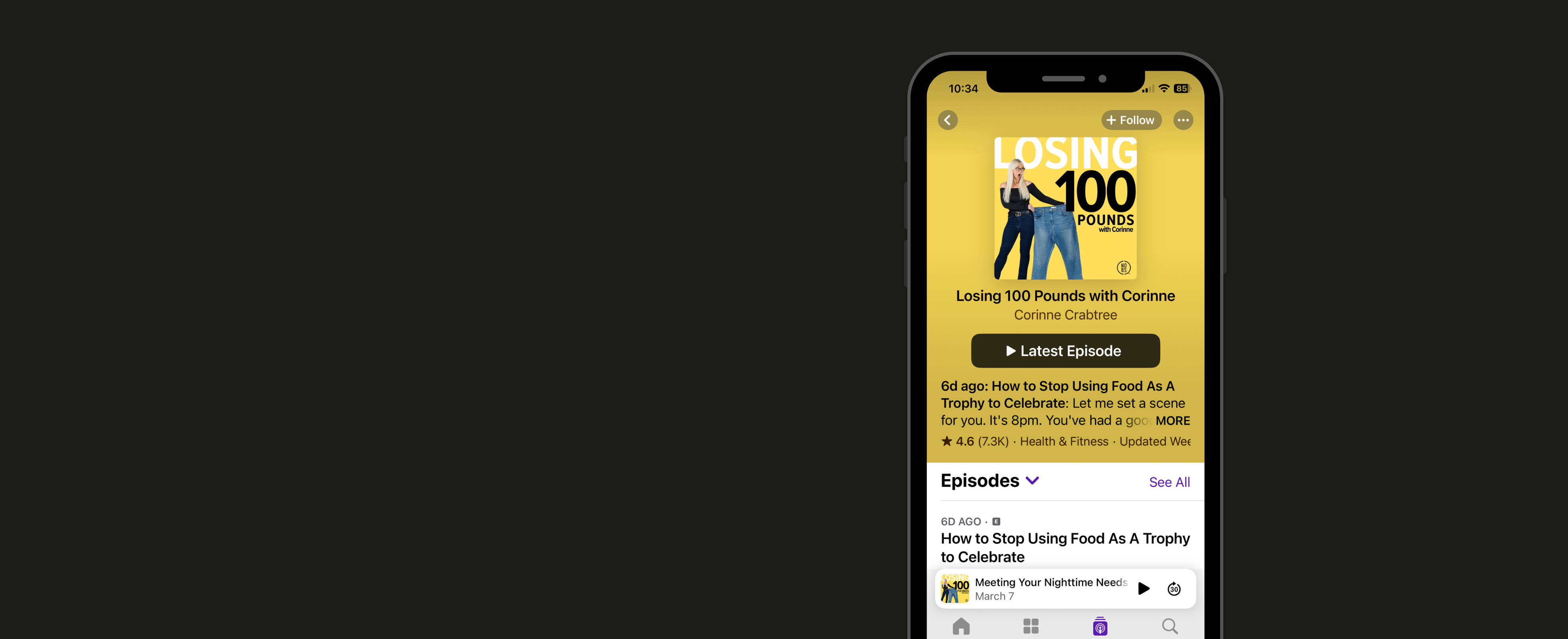
Okay, welcome back, everybody. Today, I want to talk about stress eating, but not in
a way that I think that you usually hear about stress eating from other diets or
just, I don't know, people in general, because most of the time when people say
they're stress eating, what they really mean is I'm eating when I shouldn't be
eating. And when we kind of frame it that way, when we frame it alone like that,
it makes it sound like our stress eating is a big old problem. So I want to back
this way up. And what I want to do is actually talk about what's happening in your
brain first. Because if you do not understand what's going on in your mind and I
will die on this hill when it comes to losing weight, everything else that you hear
in the diet world or in the pop psychology world, your Instagram means and shit is
going to sound like advice that you've tried and it just didn't work. So we're
going to do little neurosides with Corinne, which is amazing since y 'all know I'm
all about the common sense. But here we go. All right. So your brain, it's got one
main job. The brain is like, I need to keep you alive. That is it.
That is its mission. That it's its sole purpose. That is what drives you. It don't
give a fuck about weight loss. It could give two shits about your goals. It does
not care. Even what you promise that you're going to do on Monday morning, I'm
going to get my shit together this week. This is going to be the week that I do
it. I'm going to lose all my weight. I don't care how excited you are. That part
of your mind, it will make good plans. It will make big promises.
It loves to dream. It loves to think about things. And it genuinely thinks it's
going to do it. So I don't want you to think that your brain is just like blowing
smoke up your tail. It literally thinks that's what's going to happen. But your
brain as a whole is number one primary mission is I must keep you alive.
And anything that I think that's going to get in the way of your long -term
survival, I'm just not going to do it. So your brain, because of that mission,
is designed to scan for problems. It's always on the lookout for any little thing
that could be a danger to you and then it wants to solve those problems as fast
as fucking possible. So if it senses that you're stressed, whether that's mental
stress, emotional stress, physical stress, dickhead boss stress,
every single thing that stresses you, your brain treats it as a threat.
Here's why. Inside your mind, when your brain thinks you're stressed,
it can't, it does not distinguish the difference between I'm stressed because there's
a man in front of me with a butcher knife and a hockey mask versus Bob gave me
the side eye. So I think he doesn't think I'm doing a good job. It treats them
equally the same. So, again, if your brain senses any kind of stress,
whether that's just emotional stress, like you're having a bad day, things aren't
going the way you wanted them to, mental stress, you're staring at spreadsheets all
day long, you're grading papers, you're having to think really hard, or physical
stress, you didn't sleep good last night because your grandbabies spent the night and
you're used to getting a solid eight or you are in the middle of training for
let's say you're doing your first ever 5k whatever it is all of those stresses are
treated like they're threats so this is not where your brain is thinking oh my god
this is dramatic run for your life but it the what is really going on is that it
senses something's wrong and it needs attention, and I've got to figure it out.
I've got to solve it. So when that happens, your brain literally shifts gears. So
there's two parts of your brain. You've got one part of your brain that handles all
the logic and all the planning and all the long -term thinking, okay? We call that
the planner brain. Some people call it the logical brain. All of that's the same.
It's the reasoning brain. It's the part of your brain that is calm, cool, and
collected, it thinks. And when you are under stress,
your brain says, we got to quiet that part down. That part doesn't get to talk no
more. And the part that's focused on a lot of quick relief and efficiency,
it all takes over. This is your habit brain. This is the back part of your brain
that makes you breathe, keeps you blood pumping,
down the part that plans, shut down the part that knows I want to lose weight,
shut down the part that has my goals and my long -term health in mind. I need the
part of my brain that just does what it always does quickly to turn on. This is
not a flaw. This is absolutely how we're all designed. So do not sit there and be
like, oh my God, that's me. It's like whenever I'm stressed out. I don't even know
I start eating. I just kind of go to it. That is just how it works. So you do
not need to feel broken. You do not need to feel like something's wrong with you.
You have to fundamentally understand. If you don't want to stress yourself out
anymore, don't call yourself bullshit names like broken. Let's not do that.
I want you to say, like, oh, this is just the way brains are designed to work.
Now, That doesn't mean we can't work around the design. We'll get to that later.
But the very first thing you have to do is understand, like, oh, no wonder when
I'm stressed, it seems like it's a lot harder to make decisions in the moment that
I know are going to be good for me. In the moment, I tend to make decisions,
especially around food, that aren't that great for me. Let's say you go to the gym.
When you're really stressed out, what do you do, quit going to the gym. It's very
easy to make decisions that if you were well rested and you were just sitting
around and there wasn't a lot of stress in the moment, you would choose differently.
But in those high stress moments or when your body has a lot of stress, in the
moment, it feels really hard to make those decisions. If, like for some of us, it
doesn't even feel possible. So this is the same reason why you don't sit around
debating pros and cons. Like when you touch a hot stove like
So your brain moves very fast and it does this.
It says, I'm going to act first and then later on we'll explain things.
Stress eating works the same way. When you are stressed, your brain isn't asking
you, what is the smartest long -term decision here? That is not what your brain
does. What does it do? How the fuck do I feel better right now? That's all it
cares about. And guess what? Food is an answer to that question. We have learned
over our entire lives that food will make us feel better in this exact moment if
we just eat. Now, you are not, again, some broken -ass snowflake because you go to
food when you're stressed. Not at all. What happens when you're born? Little baby
chubby little thing comes squirting out the vajay, lands in the doctor's catchers
met. What do we do? Baby starts crying. Get that baby a bottle or a titty.
We learn from the moment we breathe real air that when we were upset that if we
eat, we will calm down. I always remember when my little boy was little,
if you're new to me, you might not know this, but my son has autism. And of
course, that first year I had no clue. Logan cried a lot. There was nothing that
soothed him other than the titty. I mean, he was on the titty, nonstop every single
time he got overstimulated every single time he was upset we all knew to give him
to me because that was the only thing that calmed him down so when we eat just
like little logan who couldn't regulate himself and he had a very anxious nervous
system as a baby eating releases dopamine dopamine is one of the chemicals that
activates our reward and pleasure center in our brain, it calms us the fuck down.
It makes us feel good. It gives our nervous system a real quick change.
It's fast. It's kind of like if you ever watch medical shows, my husband and I are
in the middle of catching up with Grey's Anatomy. We didn't get to watch it when
it first came out. We had that little baby. We missed all the shows of the 2000s
in the very beginning. We didn't even start watching regular television until about
2018.
And very often when somebody comes in and they're in a lot of pain and stuff, I
always forget what they give them. It's not, I don't know why I want to say
ketamine, but it's not ketamine, but they give them a shot of something to what?
Numb them, Calm them down fast. Food also can do that.
It's not as like drugs and it's not as instant, but it's enough for stress. So
when your body gets some food, it says, okay, things feel better.
Something's changed. I don't feel under threat anymore. Stress is not threatening me.
That's why food feels so grounding. It feels calming.
It feels good when you're stressed. It feels like you're doing something about your
stress. And that's why we do it over and over again. That's why it becomes a habit
because it actually is working just in that moment. That is why for a lot of us,
especially when we're stressed, if we're stressed eaters, when we feel stressed, the
urgency to eat will spike in our body real quick. That's not you being broken.
That is just a trained habit over time that, oh, when you feel this, when you feel
stressed, send up a powerful urge to eat, because I know she'll do it.
And I'm in the habit of sending that. I don't know what other command I really
should send because I've just been sending this one for so long, which is important
because when I say your brain is doing exactly what it's designed to do, this is
what I mean. I don't mean that your brain is now somehow fucked to where you can't
lose weight. I'm not saying that this is a sabotage. This is something real deep
that's happening, that you'll never be able to unwind, all that's happening is your
brain knows one way to solve the stress problem really fast. It's got this one way
it knows how to do. It's done it over and over. It doesn't even have to think
about it anymore. So the reason why I tell you this stuff in the podcast is
because if you're not even thinking about it anymore, you don't know how to, you
don't even know you have something you can fix. This is why people get stuck
because they're just like, something's wrong with me. Or this is just what I always
do. I'm just addicted to food. No, you're not. If you are a stress eater,
we need to work on the stresses. There are several things that we can do. But you
can't do anything about something unless you know what's really going on.
Because if you feel miserable about it, you just You just think you're broken. And
there's, why would you, if you're broken, why would you ever try new things? Because
you think this is just who you are and it's not. So most people get stuck in,
well, what do I do next? So they try to do things like outthink their stress
eating by using logic and commands. You'll sit there and if you know your stress
either, you'll say like, no. Now, I've been listening to a Crenz podcast. She says,
we don't eat when we're not hungry. So you're not hungry. Just don't eat. You don't
need this right now. So I want you to think about this.
Number one,
when you're trying to use logic, when the logical part of your brain isn't fully
online, it's going to be real hard. Most of the time, we can't pull the logic up
fast enough. Okay. Now, it's not to say that we can't figure out how to do that,
but so often people are trying to logic their way out of a stress problem when our
brain is designed to protect ourselves from stress. The second thing is we're already
stressed. And guess what we're doing? We're using command language. Don't do that.
You're not hungry you don't need this you shouldn't even be eating it like you're
jacking the stress up more so whatever was stressing you now you got you stressing
you and you're wondering why i don't know why i eat i must be broken well i know
why you're acting like a asshole to yourself so command language is stressful yelling
at yourself barking orders and telling yourself what you should do is probably never,
ever going to work. And it's just making you more stressed. You're stressing yourself
out about being stressed. So food starts to feel even more necessary in that moment.
This is why the other thing y 'all try to do that never works screws you.
And that is, I'm going to use willpower. Well, when you're stressed, power collapses
under the pressure of it. And it's not because you're so weak that you don't have
good willpower. It's because your brain is job, is to protect you,
to keep you safe. And it thinks you've got stress. I've got to prioritize relief
over you just obeying your barking bitch -ass orders. So let's talk about when the
stress eating shows up because for a lot of you, you think that it only happens at
night, but for a lot of women, stress eating is happening all day long. So let's
say you get up in the morning and you've got a, you know, your dog is vomited all
over the carpet and your kids forgot their homework. It took you forever get out of
the house. And you had traffic. You come cruising into work, first thing you do is
grab email and somebody is having a bad day and you are the target.
What do you do? We grab that mid -morning snack. I don't know why I'm so hungry
today. Well, it could be the hard day, the hard morning. Sometimes we're snacking
between errands. We're eating in our car because we're not taking any real breaks.
We're running errands during lunch And so we're just woofing food down in the car.
And next thing you know, you're going to need extra snacks because stress didn't go
away. And when you ate, you weren't paying attention so you didn't even get to feel
the relief you thought you would feel. Some of us just eat at home when we're
stressed. We come home and it's not even the night time yet. We're standing at the
counter popping shit in our mouth the entire time that we are sitting there cooking
dinner and by the time dinner rolls around, guess what? We got a booty belly and
then we feel terrible that we're full, but then we eat anyway because we work so
hard to cook the dinner. So sometimes stress eating only happens at night for women
because they are so busy during the day. They're so mentally distracted. The stress
is compounding and at night they eat. And for some of us, We don't. We grab ass
little bits of food all day long by just, it's a handful of nuts here.
It's one piece of candy that won't hurt there. It's dined by a thousand cuts for
weight loss. So the common thread is never the time of day of when things happen.
The common thread is how much shit are you trying to hold together every day.
Because most women don't give themselves credit for how truly disciplined we really
are every single day. And I don't mean with diet discipline. I mean, we have a lot
of life discipline. Drives me crazy when women tell me the reason why they can't
lose weight is because they ain't got enough discipline. I'm like, bull fucking shit.
95 % of the women I know, we're too disciplined.
We got to get up.
anybody never ask for help we may be seething on the inside we may be angry on
the inside and i will tell you if you're seething and angry about all your
responsibilities that is your body's way of saying you need to speak up for yourself
you need to start asking for help this is like your body saying warning you are
setting no boundaries in life. And I don't mean going out to other people, but
you're not even setting them with yourself. You're not even allowing yourself to say
no to things. You absolutely could say no to. You just don't for fear of hurting
someone's feelings. You don't say no because you never have before. You don't say no
because you're like, well, I do it better. And you don't want to watch somebody
else do it the way you don't do it. The other thing that we do is we do a lot
of managing other people's emotions all day long. We're dancing around, trying to
keep everybody happy, juggling life, so we don't upset anybody. Another way that
you're disciplined, how many of you are listening to this, and you ignore your
hunger all day long because you're busy. That requires an immense amount of
discipline. I'm not saying it's good. I'm just saying that's one way that we
exercise so much discipline. And then the other way that we do it is we push
through exhaustion because we feel like we have to. And there are times where we
absolutely do. All of that is using willpower and discipline. It's a lot of effort
for us. And when food shows up in the middle of that type of living and all of
that chaos, you're not eating because you're out of control.
can get to the next thing.
That is why diets completely miss the point. All of you who keep trying to do
Weight Watchers and you keep trying to do keto and you keep trying to do
Mediterranean, whatever they are out there. Most diets are like,
hey,
I got a plan. Buy my shakes, get my shots, take my pills,
cut out these foods, don't eat these things, only eat this many number of calories.
They do a lot of that. And I'm not saying that stuff's bad. Like, honestly, fine.
But anytime a diet only takes away the food and it doesn't help you deal with
life, it's not a good situation for you. Because for us,
if you're anything like me, food isn't just food for you. When a diet takes away
things, it also takes away your comfort. It takes the way you get relief.
It takes the way you get energy. It takes away how you cope with the hard shit of
life, the day -to -day hard things in life. So when a diet takes that away and they
do not help you build other ways to cope, no wonder we break under the pressure of
the diet. Because life is still happening and they're not helping us with any of
the reasons why we need to eat. So for a lot of women,
We start a diet, and in the very beginning, it feels great. We feel like, oh,
finally, I know what to do. You do well for a few days. You might even see the
scale go down. And you're kind of in the honeymoon period. And then eventually,
you're just losing one to two pounds a week. And life is still happening.
And you don't have any other way to deal with stress and it all starts catching up
and the next thing you know the stress of life is so much louder than any of the
good that might be coming from a diet so we break and that's not you failing it's
just predictable what else should happen and i want to make this really personal
because this is something that I have experienced. There was a time in my life
where I ate ice cream all night long. And I'm going to tell you,
I mean, I do love ice cream, but I didn't love it as much as I thought I did.
I was never hungry for it at night. I ate it at night when my house finally got
quiet because my son was high needs. And all day long,
not only was I trying to take care of him, but I also was under the weight and
pressure of all the things that I thought. I thought, I can't make this baby happy.
There must be something wrong with me as a mother. What if I'd done with my life?
And then I would feel guilty for sometimes wishing that I hadn't even had a child
because I never knew how heart it was going to be. And then because I was eating
so much, I felt fat as fuck. I was over 250 pounds. And I was so worried my
husband would leave me. He never said anything about that. He always loved me. He
always supported me. But in my mind, because I felt disgusting, I couldn't imagine
that one day he wouldn't look at me and just be like, I'm disgusted with you too.
And he would just leave me. And I sat under that stress all day, every day,
calling myself lazy, destined to be fat. I don't have what other women have,
feeling guilt. And I really believed back then that the reason I was eating ice
cream was because I loved it. But it dawned on me one day that I was eating the
ice cream because I was so stressed from not only the way I talked about myself
all day, but also just what I went through every day with my child. Ice cream was
never my problem. The real problem was all of the stress,
the emotional stress, the physical stress of being the weight I was, the mental
stress that I was under, that was the problem. And instead of like questioning,
why do I feel so guilty when my husband says he's happy to take the baby? Why do
I feel like he's going to leave me? When I'm sitting there listening to him say
that he loves me, why am I feeling like I made a mistake instead of,
this is just the hard part. it is hard to be a mom. This is very different than
anything you've ever done and you don't know how to do it yet. So instead of
questioning all that, I would eat to feel better. So ice cream was never my
problem. Feeling guilty was, feeling like I was broken,
feeling like I was in danger of losing my marriage, that was always the problem.
I'm just telling y 'all right now that when I finally saw that,
everything changed. That's when I was able to start losing weight because I really
figured out the real problem. And when you know the problem, you know the right
solution. And the right solution isn't to join keto for the hundredth time,
to go back to Weight Watchers for the hundredth time. Because none of us who
struggle with weight like this when we are stress eaters, we don't need to be
trying harder. We don't need stricter rules. And we definitely don't need to cut out
all the foods that we cope with. What I needed to realize was I wasn't doing
anything wrong. But I was in a hard time of my life. Of course I wasn't enjoying
it. Of course I needed support. Of course I needed comfort. Food wasn't me eating
my face off. And food was not proof that I was going to be fat for the rest of
my life. It wasn't proof that I couldn't lose weight. It wasn't proof that I failed
every time I tried. It was proof that I needed help and I needed compassion.
And this is why diagnosing the right problem matters so much in weight loss. This
is the same thing we talked about in the last episode, in one of my previous
episodes
with, like if you have a doctor and you go in with a wicked headache and you say,
I got a headache. If they're just throwing Tylenol at you, If they don't ask you
any questions, they could mess something up. Because if the headache is coming from
stress or exhaustion, high blood pressure, a litany of things,
they could give you the wrong solution. And you could never feel better. You could
feel better for four hours at a time with that Tylenol and the right back where
you started. So we have to remember that stress eating works the same way.
We have to figure out when it comes to losing weight. We have to diagnose the
right problems.
Because if we diagnose the problem as you lack discipline, you're going to just keep
throwing more discipline and stricter diets at it. But if the real problem is guilt,
emotional overload, exhaustion, pressure, over disciplining yourself all day long,
then discipline is the wrong medicine. And this is why the first step to changing
stress eating isn't stopping the eating. It's always noticing.
You got to notice when you're stress eating. You got to notice what's going on in
your life. Inside my program, I do teach a four -part process for fixing this kind
of eating in particular. Now, I can't teach you all of it here, of course, because
really unwinding this stuff, it takes someone like me who knows what they're doing.
And it takes someone like me who can step out of your emotions and help you see
things through a new perspective. But I can give you the first step because This is
the one almost everyone skips, and it is, you've got to notice. You have to notice
when the urge to eat shows up. You got to notice what's happening around you
because those urges come so fast. Remember, that brain of yours, what does it want
to do? Sense a threat, extinguish it immediately. So when you are having these
urges, you need to see them. You need to start taking note of like, what's
triggering this? What goes on that could be leading to this? Start noticing what am
I trying to get through when I eat? What am I trying to push through? What am I
trying to get through? Because if you don't notice the right problem, how are you
ever supposed to apply the right solution? If you don't know the right problem,
you're just guessing. And you're likely going to guess wrong because most of us,
what do we do? We go back to the well of diets that never worked because they
were never solving the right problem. So when you want to eat and you're not
hungry, the most useful question isn't what should I do instead? It's what am I
needing right now? Am I needing a break? Comfort, reassurance,
permission to stop, because once you can name that, the urge stops feeling like
you're failing all of the time. Now, when you start noticing, you're going to get a
lot of relief in noticing, but until you start fixing the real things,
you'll probably also keep eating. And that is okay. But sometimes you might not
because you're going to realize, oh, food isn't the answer right now. I'm just
overwhelmed.
And sometimes enough awareness will lower the stress to a point where you can make
a better decision because that logical brain can come back into the room. But a lot
of times, you won't know what to do when you're overwhelmed. And that's where
somebody like me would come in. So you don't stop stress eating by