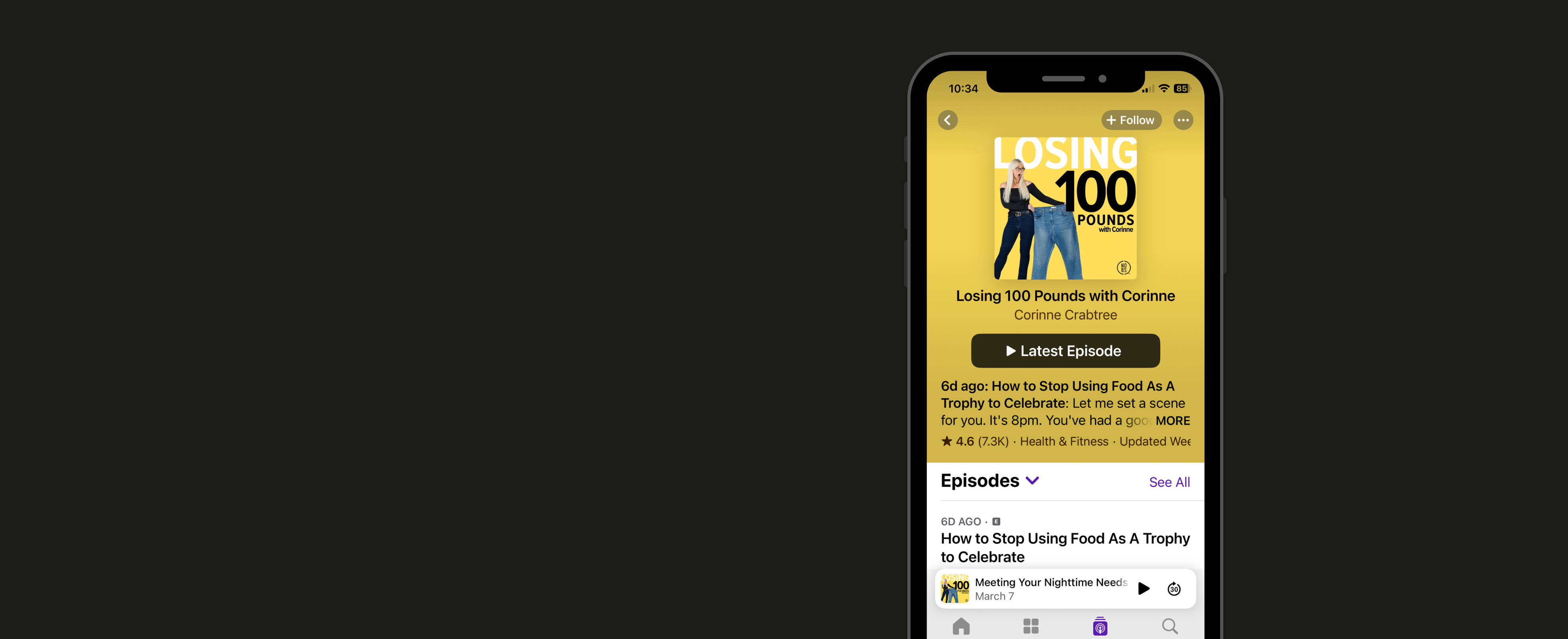
All right, everybody, welcome back.
Today, what we're going to do is talk about why eating healthy can feel so damn hard for some of us. And I want to tell you, this is important because I think a lot of women are sitting around with the wrong idea about why it's hard for us.
So a lot of people think it's hard because you don't have the willpower. You think it's because you don't know enough about what's right and what's wrong. And sometimes it can even feel like everybody in the world around you got some kind of special health manual, and you missed out on it.
And maybe you've tried and failed so many times to lose weight that you've decided you must just be one of those women who can't eat healthy, who is addicted to too many foods, or that certain foods just taste so good you'll never have any kind of control around them.
Now, I wanted to say all that up front because none of that is what's really going on with you.
When we talk about eating healthy, eating healthy feels hard because we've taken something that's actually very simple and we've made it into the most complicated, big-ass problem in the entire world. And a problem that feels really big, nearly impossible, what it does is it kind of just freezes you up, which means that you sit around wanting to eat healthy but not really doing anything about it.
And we sit around wanting to get started losing weight and eating healthy, but we convince ourselves, I don't even know where to start.
So what do we do? We sit on the fucking sidelines. We don't do jack shit. We just kind of stay in what my mentor always calls the miserable maybe, which is basically where maybe one day I'll be able to lose weight. Maybe one day I'll get my shit together. Maybe one day I'll be motivated. Maybe one day I will just want to do this.
And that gives us a little bit of hope, but we're also sitting there the entire time still afraid we can't do it. And we're also sitting there feeling confused about where to start. And we're sitting there feeling like now's not a good time.
But wanting. I think one of the hardest things in life is to want something so bad and not go after it.
Just think about all the times you've really wanted to lose weight. It's not fun to want to lose weight really bad. It just isn't.
Now, there's a difference between wanting to lose weight and, like, I really want to go on a vacation. And so then you make the plans because you feel capable of going on vacation.
But with weight loss, we feel so fucking incapable. So we spend our entire life wishing, wanting, and pining for these things to just be different. And that is just a hard place to be.
So I wanted to just say that right up top because I have all kinds of understanding about this. I did this most of my life. And I don't want another woman who comes across my podcast ever living like that anymore.
What I hope is that my podcast gives you just enough information every single week to where you can get more and more brave and more and more confident that it's okay to start.
All right? So let's go back to what I was talking about when we are saying that we can make our problems bigger than they need to be.
So make sure you stay until the end because when we're done, I know you're going to feel a whole lot better about eating than you do right now. Because I'm going to show you how all of this got so complicated in the first place, why it's not your fault, and then I'm going to give you just one little bitty question that you can ask yourself that does a lot of this work for you.
So when we say the problem is too big, we've made our problem too big. This is what I mean.
When I first started losing weight, I would get on the scale, and anytime it went up or I didn't lose, I knew exactly what I was going to think.
I'd start thinking, see, you failed so many times. There's just no way you can lose weight.
And look at what I just did to myself. In that moment, I took one morning on the scale and I turned it into every diet that I'd ever failed.
Now, to lose weight today, I needed every one of those past diets to have somehow worked. Just think about the way that I made the problem. It is an impossible problem to solve.
If every time you weigh in and you don't get what you want, you automatically turn that into every diet in my past was a failure, therefore that means this one's failing, now we have too big of a problem to have to solve.
There is not one thing that you can do today about every diet you have failed since 1995.
So for me, when that would happen, I would just stand there on the scale feeling hopeless as fuck. And then guess what I'd go do after that? I'd go eat my face off because I'd be thinking, why bother? I'd feel like such shit about it.
Now, these days, when I get on the scale and a couple of pounds is showing that I've gained, my first thought is, girl, what were the things that could have led to that this week?
My thinking is a whole lot different now. I think, okay, I bet there were some small things this week I could have done a little different. Let me go find those so I can do something about it this week.
And usually, I can find one in about four seconds. One little thing that I could change. Maybe I ate out a few extra times. Maybe I was grazing at night because work's kicking my ass. Whatever it is, it's one small thing from this week.
And when it's only something from this week, I feel better that I can do something about it. Now I've only got one week to look at. I'm not dragging 30 years of my sorry-ass diet history into the bathroom with me every single morning before I weigh.
I've got a small problem I can actually solve, and I can probably solve it by the next weigh-in.
So we're talking the same scale. I'm getting on the same scale as anybody else, gaining the same amount of weight as anybody else. But one version of me can make this a problem so big that I'm going to freeze and I can't fix it. And the other version of me is deciding on purpose to make the problem small enough that I can feel like, okay, this is doable. I can do something about that this week.
The only thing that really changes, and I need you to hear me say this, the only thing that changed was how big of a problem I was making things in my head.
And that's the whole point of today. This is what I want you learning today.
We're not going to be talking about how you eat perfectly. We're not going to talk about, like, this is my opinion on what people should and shouldn't be eating.
We're going to be talking about how do you take the giant problem about eating healthy that you've been carrying around, and how are we going to make it small enough to where you can actually do something about it, okay?
Now, before we talk about it, I want to tell you why we are so confused when it comes to eating healthy, because I know you're probably confused, and there's a lot of good reasons for it.
So here's just a couple.
Number one is all the dieting that you've done. Every diet you've ever done, it gave you a lot of rules, and it dropped them right into that pretty little head of yours.
And inside your head, your brain said, I'm going to file every one of these away like it's the goddamn truth. Like it's the only way that ever works.
So if you've been dieting for 20 or 30 years, you don't just have, like, one set of rules that Jane Fonda gave you or, what was it, Susan Powter gave you. No, you have got all the rules in there from Jane Fonda, Susan Powter, Weight Watchers, the low-carb phase, the keto bros, all of it.
They're all sitting there. So you've got at least 20 sets of rules, and most of them are fighting with each other.
One diet said you can't have bread. The next one said bread's fine. It's really sugar that's the devil. Then one came along and said, hey, fruit is too much sugar, so you should cut that out. And then the next one said, eat all the fruit you want. Just don't have any carbs after six o'clock at night.
So now we're just standing there in our own fucking kitchen, terrified of a damn banana looking at us, because we've got four different voices in our head at one moment, all calling back to some rando diet that we probably bought off of a magazine while we were standing in the grocery store back in the 90s. And they're all sitting there calling the other one a liar.
It is no wonder you don't trust yourself to just decide what you should and shouldn't eat.
Now, the second thing that happens, it's bigger, but it's also like, you know, like a good fart. Silent but violent.
So underneath all of it, you're afraid that you can't do this, that you just can't lose weight. And when you're afraid you can't lose weight, being confused about what to do actually creates what we call a sense of safety.
So I want you to think about this. If you let yourself be confused, if you allow yourself to be like, I just don't know what to do, so I'm just not going to do anything. I'll figure this out tomorrow. If you get to say, I just don't know what to eat, then you don't also have to sit in the scarier feelings, the one where you're afraid you're never going to figure it out.
If you're not actively trying, guess what? You don't also have to be triggered that you might be doing it wrong. And we would rather be confused. That feels better than being afraid.
So sometimes, it's like we're staying confused on purpose.
Now, I don't think you want to be confused on purpose, but it's like a self-sabotage loop in our head.
Our brain is thinking, oh my God, well, I don't want you terrified of food, and I don't want you triggered that you're doing it wrong, and I don't want you sitting around in anxiety about whether or not you're right or wrong. So I'll tell you what, let's be confused. That's a lot better than hopeless.
Being confused means, well, you know, I just need to figure this out first. It feels better.
But here's the problem. You already know basic common sense when it comes to food. We all do.
For example, if you came home and you saw a couple of cookies on the counter, common sense says a couple of cookies is not going to hurt anything. No woman listening to this is overweight because every now and then she eats a couple of cookies and moves on.
You would never sit your children down and say, all right, now listen, baby, I need you to never eat cookies because cookies actually have magical powers and they control you. And the second one touches your lips, for the rest of your life, you will have to eat way too many of them.
And that sounds batshit crazy, right?
Because it is.
But that is the exact thing that we are telling ourselves every single day.
So sometimes we just have to hear somebody like me state the obvious. Would you ever tell your children half the shit you tell yourself? Probably not, which means we shouldn't tell ourselves that.
And when you hear it, you need to correct it for yourself.
Because a lot of what you tell yourself, like all your foods that you love mean you're out of control, well, that's a huge problem to solve. And we don't want to create big-ass problems for ourselves. We want to create small-ass problems because small-ass problems come with small-ass solutions.
So I want to be really clear because this matters more than anything else I'm going to say today.
If you lose control around a food, it is not because that food has got magical powers. It ain't like Lucky Charms.
I want you to think back to the last time you ate cookies and you couldn't stop.
The whole time you were eating them, I would bet you this is what was going on in your head. You were thinking, I shouldn't be doing this. Well, see, I've blown it now. I might as well get these out of my system. You probably were thinking, why do I even bother? I always screw up.
All of that food noise right there, all of that shame and judgment, that is what makes you keep eating. It was never the fucking Oreos. It was every bit of food noise where you were telling yourself why it's so wrong the way you're doing it.
And when that's happening, you're going to feel hopeless. And hopeless people eat too much because they need to feel better. They also will eat too much because they want to shut that voice off.
If you eat enough food, you'll start feeling miserable, and you'll start thinking about how full you are instead of how wrong you are.
Because this is the truth.
If you ate a couple of cookies and you didn't pile all the extras on top, you just go, oh, I wasn't really planning on cookies. If you didn't have all that bullshit going on in your head, what would you do?
You'd probably just stop like a normal person and say, like, oh yeah, I wasn't going to eat the cookies. And you'd put the rest of them down, and you would just go about your goddamn day. That's it. It would not be a big deal.
But that's not what we do because we've got a head full of diet rules that say cookies are bad. And underneath that, we're scared that we can't lose weight anyway.
So you stack a head full of frightening-ass rules on top of a woman who's scared as shit that she's always going to fail, and of course, deciding what to eat feels damn near impossible.
You're not even confused about the food. You're just scared that you're doing it wrong. So you just assume you must not have enough rules. You must not have found the right ones. You must just be confused.
Okay, so let's talk now about how do we take a big problem and make it smaller? Because this is the part that I think is going to really help you today.
And it comes down to the sentence that you're going to say in your head about your problem.
I'm going to give you a real-life example so that you can really get into this and see this is what needs to change.
So a lot of women say, the problem is I can't eat the foods I love and lose weight.
Now I want you to think about that. That is a big fucking problem.
I can't eat the foods I love and lose weight.
That lumps every single food that you love into one giant fucking pile and says, all of this is off limits. Every food is off limits forever, no matter what.
And that is a massive, miserable problem. And that means no wonder we don't want to start, we're afraid to start, or that if we do a dumbass diet, we immediately feel deprived and restricted.
Because what do we do when we start diets? We tend to just stop eating all the foods that we, quote unquote, lose control over.
But that is almost never true.
So, like, a lot of times when I'm coaching women, it's never every food that she really loves. Very often, there are a few foods that do trigger her, and she eats too many of them.
And it's triggering her because when she eats the food, she immediately assumes she's wrong. She immediately beats herself up.
And those foods are the ones that we now want to say, all right, smaller problem.
There are certain foods that, when I eat them, they trigger me to feel bad about myself. And so I need to work on the real problem, feeling bad about myself over the few foods that I have a lot of rules around.
So my actual problem is with these foods, I need someone to help me break the rules, rewire new ones, and teach me how to think about them in a brand-new way.
Now, we can even make this problem a little smaller because usually, it's not even those foods all the time.
Let's say that you love cake. If you really watch yourself, you might notice that when you go to a friend's house and there's cake, you have a piece and you're totally fine. You might judge yourself and stuff, but you don't automatically throw your face down in it saying, I'm out of control, bitch. Why did you have cake? I can't stop right now.
Most of us can stop when somebody else is watching.
But when we're home and we're alone and we're stressed out after a hard day, we can have the same cake in our house, and it's a whole different story.
So when we think about what is the real problem, the real problem isn't cake. The small problem is when I've had a long, hard day, I don't know how to decompress any other way than eating.
So my small problem now becomes, I need someone to show me either, or I mean and either, I need somebody to show me how to actually not get so stressed out each day. So where are all the places that, during the day, I might be unintentionally stressing myself out?
And second, I need someone to show me how to cope with hard days in new ways.
Because if I had to guess, if you're an emotional eater, no one's ever showed you how.
So when you make the problem small, you can finally see what actually is going on. And when you see what's going on, it's a lot easier to fix.
So that's what we want to do. We want to take these big, giant, sweeping sentences like, I can't eat the foods I love and lose weight. And you keep asking yourself, well, what's the smaller, truer version of this? What's the smaller problem here?
And until you've got something small enough to actually do something about, don't try solving it.
That's where you want to start.
Okay, so let me tell you about two places that I watch women make the biggest mistake possible, the biggest problem ever, because I would put good money on one of these sounding very familiar to you.
And the first one is the woman who is just drowning in how much she's supposed to be eating.
She's going to be standing in her kitchen, trying to figure out how much to put on her plate, worried the whole time that it's too much.
And the honest-to-God truth is, she doesn't even know how much is too much and how much is even too little because she hasn't measured anything in years. She really doesn't have an idea of what a portion even is anymore.
And then the second somebody tells her to pull out a measuring cup and some tablespoons, she feels like she's back on a diet. It triggers her to feel very restricted, very deprived. And she's going to usually quit before she even starts because she doesn't want to feel those things.
So if that's you, I want you to think about how big a problem you're making this out to be.
You've made feeding yourself into an impossible math test that you are very scared you're going to fail. So you just keep not taking the test year after year.
You're not trying to do anything that would get you in the realm of knowing, this is probably a good size for me.
So here's a smaller problem.
You do not, I promise you, do not actually need to count or measure a single thing in order to lose weight.
Let me tell you something that's going to take a lot of pressure off of you.
Every meal you eat is really just made up of a few simple little things.
All right, there's protein. That's things like chicken, eggs, fish, beans, that kind of shit. We all know what protein is. Most protein outside of beans and shit had eyeballs at one point. It could look at us. It could make noises.
We all need a carb at most meals. A carb is things like rice, potato, some bread, fruit.
And then we also need fat in our diet. That's like butter, oil, avocado.
That's it. That's really what we need to know about food.
Now, in order to measure it, all you need is your hand.
So when we think about making food a smaller problem, rather than thinking, I can do this right or wrong, if you really thought, you know what, I'm going to get really good at each meal for this week, paying attention to how much I'm serving myself. I just want to kind of see what it looks like.
And then next week, I'm going to try Corinne's hand method. I'm going to just see what the difference is.
That's a small problem.
And the hand method is really simple. Your thumb is like how much fat you need per meal. The size of your fist is about how much carb you need. Your palm is about how much protein you need in a meal. And then we round some shit out with fruits and veggies.
That's, like, all we got to do.
So when I say fats, proteins, and carbs, most meals should represent those things. And if you're just serving yourself based on your hand, I promise all of you who are listening to me right now, you are doing better than 90% of the people listening to this podcast.
If you just did that and you never got out a measuring cup, and you never counted your macros, and you never got real anal about things, if you just said at each meal, I'm going to have a carb, a protein, and a fat, and we don't even worry about fruits and vegetables yet, you're doing better than most people.
And then you take that meal and you round it out with some vegetables. And if you want your fat to be butter all over your veggies, girl, more power to you.
That is how simple eating can be for healthiness.
But when we talk about eating healthy, oh my God, we make it such a big fucking problem.
So one of the things that I do inside my program is I just teach women dead-simple ways to eat healthy with your hands, your brain, and your eyes. That's the only three things you're going to need. That's it.
I don't want women overcomplicating it. I don't want you using cups and scales.
One of the things I teach my women all the time is that if it ain't simple, you're not going to do it. So we want to keep things simple because simple means it started off as a small problem.
So the second place women make things too big of a deal is you think the second you've messed up, if you eat the wrong thing, you eat a little bit too much, that you're not perfect anymore. And that means you've blown it.
And we all know this.
We can be, like, really good all day. We can eat all the things we're supposed to. But then the second the kids go to bed and the second the house gets quiet, for some reason, we all of a sudden turn into the Cookie Monster, and we are off to the races.
Nom, nom, nom, nom, nom, nom, nom.
And instead of it being a small problem, like, huh, I wonder why when my kids go to bed, this is the one time of day I have a hard time. I wonder what that's all about.
We make it into a big problem of, I always screw up. I'll never get this.
Think about those two words, always and never. Like, that means I need to always get it right if I never get it right. And then I always screw up means I'm going to have to never screw up.
I would love to just, like, if I could, take the old magic eraser and scrub the words always and never right out of y'all's brains. Because the second you hear those words, I want you to think, I am creating a very big problem to solve. And I bet you there is a smaller problem to be solved. I just have to think about it in a small way.
So here is the small question that I want you to put right now in your back pocket from here on out.
When you catch yourself staring down some giant version of your eating, feeling that wave of overwhelm coming over you, I want you to stop, take a few deep breaths, and I want you to ask yourself, if I only had to do one thing a little bit better, what would that be?
If I only had to do one thing a little bit better this week, what would it be?
If I only had to do one thing a little bit better at the next meal, what would that be?
If I only had to do one thing a little bit better than I did yesterday, what would that be?
If I only had to do one thing a little bit better than the last time I tried to lose weight, I wonder what that would be.
That right there, that's the only question you really need to be asking.
You don't need to ask, how do I fix my entire diet? How do I finally become a perfect eater after 50 years of failing? Those are the big, giant questions that you're asking. And a giant question will freeze you stone cold every single time.
Just what's that one thing?
Because the one thing, you can see it. And the one thing is something that you probably can actually do.
I was just on a coaching call with my members, and someone asked me, she said, I lost a bunch of weight a few years ago. I joined No BS because I've regained all that weight that I lost a few years ago back. But I need to know how to trust myself and commit fully to the journey ahead of me.
And I said, oh my God, girl, I'm telling you right now. You do not need to trust yourself for the whole journey.
Just think about how enormous that problem is. If you don't trust yourself now, for the whole journey, it's probably because you have a whole backlog of shit you're going to have to overcome. We ain't got time for that shit.
So I broke it down into the one simple question.
If I was only looking at today, what could I trust myself to do today even if I didn't feel like it?
Just name one thing and then you go do that.
If I was going to be committed to doing something today to lose weight for my health, what would it be? But I have to be able to talk myself into it the moment I don't feel like it.
Y'all need to be asking those questions because I'm going to tell you right now, when it comes to losing weight and eating healthy, it does not have to be a giant, miserable-ass thing that you make it out to be.
I know it has felt that way, but it doesn't have to feel that way. We can change that. And it really only takes taking a few deep breaths, listening for how you're talking about it, slowing it down, and then making a different decision.
Okay, if you are interested in eating healthier, I want you to check the show notes of this podcast because I have a brand-new, very small course that I just released called Healthify.
All it is is the simple, common-sense basics that I teach on how to eat better. This is not for your weight loss. This is for anyone who's interested in, like, you know what, Corinne, I want to eat healthier. I don't even know where to begin, and I want the most butt-ass simple way to do it.
I don't want measuring cups. I don't want scales. I don't want to have to do elaborate planning. And I for fuck sure don't want food lists. I don't want you to tell me that I have to take anything away.
That's what's inside this little course. It will make eating so much simpler for you so that you have a small problem. Each and every little video, we just solve one little tiny problem instead of everything being a big-ass problem when it comes to eating healthier.
So check the show notes. You'll see a link to where you can get it.
And if you are a No BS woman who's already working with me, guess what? It's included, girl. You ain't got to do jack shit other than log into your member site. Push play.
All right. That is it for today. You all have a good week, and I'll see you next week.